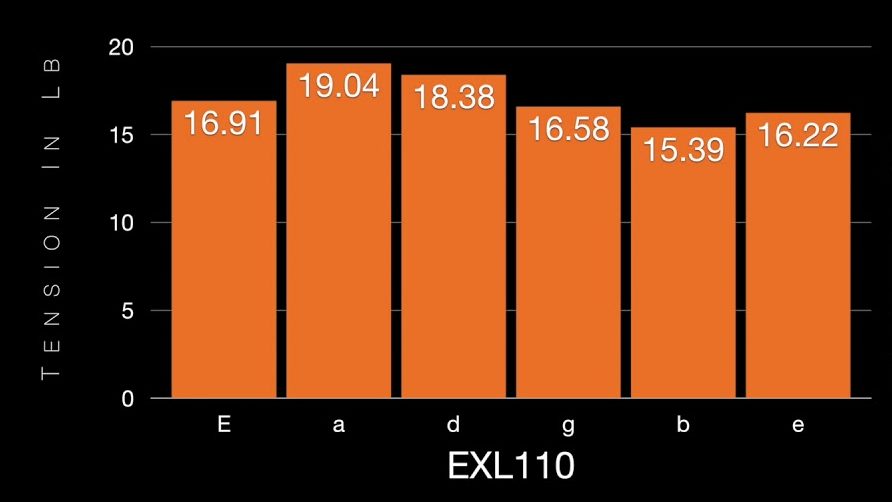
Did you know that for a set of gauge 10’s the A and D strings are 15% higher tension than the others? For a set of gauge 9’s the B string is 13% lower tension than the others. Then if you drop D your low D is 26% lower tension than the A string.

So you have a different feel across the board, higher tension strings feel harder to bend. Lower tension strings are more likely to go sharp when you strike them, and hold tuning poorly.
Why do they make them like this?
The same reason that Gibson won’t use a scarf joint to reduce those famous headstock snaps – “because we’ve always done it this way”. Don’t get me wrong, I love Gibson – I own an explorer and it’s amazing. We like stuff that feels familiar, so it sells well. The Gibson headstock fragility is an endearment for some reason, maybe clever marketing. Imagine if us Gibson fans actually thought with our heads, we would have “headstock-gate”, and things would change overnight. But we don’t, we are foolish romatic musicians and it’s great. Same goes for the strings, the high tension 4th and 5th strings feel familiar. Everyone knows exactly what to expect when asking for a set of gauge 10’s.
String nerd
Anyone that has hung out with me for more than 15 mins knows they’ll be on the receiving end of a string tension mini-lecture. Armed with my Excel string tension calculator I can bore any poor customer that unwittingly asked about string choices for a solid 20 mins. Many years ago I got nerdy about string tension as there didn’t seem to be a set I could buy that felt nice and even across the board. So I started buying single strings with sets to make balanced tension hybrid sets. For example, a set of 10’s and a single 0.050″ for drop D, a set of 10’s a 0.024″ and a 0.034″ for a standard E tuning set. For 8 strings a set of gauge 9’s but replace the 11 with a 12 and add a 54 and a 72 for the lower strings. Fast forward to the present day and I now buy stock of pretty much every string gauge so that I can calculate a balanced tension set for any scale length and tuning. This is especially relevant in the modern guitar industry when we have things like multiscale 8 string guitars with unconventional tunings. But even if you play E standard I would strongly recommend trying balanced tension at least once.
What tension do I need?
I like a “medium” tension – around 16-17lbs per string. “high” tension would be around 20lbs and “low” would be around 12-13lbs.

Tony Iommi plays 9-42 in C# standard, around 9lbs per string. As you might know this is because he lost the tips of two fingers in an industrial accident in the early days of Sabbath. I would say 9lbs is “very low” and would advise anyone against it. Tony makes it work and is always in tune, but then he is Tony Iommi so the strings wouldn’t dare go out of tune.

Stevie Ray Vaughan played 13-58 in Eb and his guitar tech recalls shredded fingers after shows. This is 25lbs of tension per string and is “very high”. Again, not something I would advise, but then SRV is a god like Iommi so what do I know? Maybe it’s worth a try.

It doesn’t stop there, The Quo have been known to use 14-56! In various tunings, but some strings reaching over 30lbs of tension. That’s what a scientist would call “really very high indeed”. If I was Rick Parfitt’s guitar tech I’d be wearing goggles and gloves for string changes for sure.
What affects string tension?
Generally speaking, going from Gibson scale (24.75″) to Fender scale (25.5″) increases single string tension by 1lb. This is why many Gibson players prefer gauge 10’s and many Fender players like gauge 9’s.
It’s a bit more complicated with gauges. Going up from a 0.009″ to a 0.010″ on the 1st string (high E) increases tension from 13lbs to 16lbs. But going from 0.042″ to 0.043″ on the 6th string (low E) increases from 14.76lbs to only 15.42lbs. There is a bigger effect, as you might imagine, on the thinner strings.
This is why I made a string tension calculator, which you can download below.
Dude, no one cares
D’Addario make a few balanced tension string sets, but they do not sell anywhere near as well as the classic sets for reasons discussed earlier. In early 2022 I met the boss of Newtone strings at a guitar show, a very nice chap who hand makes strings in Derby. I’d recommend trying his strings, to my ears they are a bit more metallic than D’Addario so might be a great choice for styles of music that lend themselves to that.
We started talking nerdy string stuff and that led to me designing several sets of balanced tension drop tuning strings, as I know many local guitarists that play in drop C#, drop C and drop B. With my logo proudly on the Newtone string packet, and visions of making a fortune by finding a niche in the guitar industry, I ordered lots of stock and advertised it… and I still have some of them left over a year later.
Turns out not many guitarists really care about balanced string tension *sobs*.
How to do it
1) Get in touch with your tuning, scale length and preferred tension. I’ll calculate a set for you at no charge. You can also drop your guitar off at the workshop and tell me your tuning and preferred feel, for example “soft”, “medium” or “tight”. If you’re not sure of your scale length you can let me know what guitar you have and I’ll look it up. It is sometimes a couple of quid more expensive to run balanced tension string sets, but I think its worth it and have been doing so for many years.
2) DIY with my string tension calculator. You can download this Excel spreadsheet (or ODS sheet) and dial in your perfect set. At the moment I have only made one for nickel wound electric guitar strings.
Agrajag string tension calculator (XML format)
Agrajag string tension calculator (ODS format)
This is a great site for bass strings:
Don’t even get me started about acoustic string tension, it’s in even worse shape. Just look at these tensions for 10’s, 11’s and 12’s from the Elixir website (Elixir use D’Addario strings and coat them).

The tensions vary from 20lbs to 30lbs on the most popular gauge 11 set, if you ask me that should be enough to trigger “acoustic-string-gate”.
 Agrajag Guitars